Forward Deployed EngineerSenior AI Engineer

EmmanuelOnwubuya

I turn ambiguous business problems into production AI systems, data platforms, and products.

Forward Deployed Engineer and Senior AI Engineer working across customer discovery, system architecture, LLM applications, data infrastructure, APIs, deployment, and post-launch iteration.

  • LLM Systems
  • RAG
  • Agents
  • Data Platforms
  • FastAPI
  • Databricks
  • Production AI
system.graph reference architecture
01datasetevents.delta
02pipelinelakeflow.job
03vector storehybrid.index
04retrieverscope + rank
05LLMroute + tools
06APIFastAPI

Illustrative architecture · no live data

01 / About

Work the problem,
then build the system.

I work at the intersection of AI engineering, data platforms, and product delivery.

My work usually starts with an unclear business problem: understand the workflow, identify where AI or data can actually help, design the system, build the first working version, put it in front of users, measure it, and iterate.

My background in distributed data engineering means I am comfortable below the LLM layer too—pipelines, schemas, retrieval infrastructure, APIs, databases, cloud systems, observability, and production reliability.

I have done this inside enterprise environments, consulting engagements, and products I have built myself.

Operating rangeStakeholder context → system design → production ownership

02 / Expertise

Capabilities across the stack.

I connect customer context to the data, software, and AI infrastructure required to ship.

01

Applied AI &
LLM Systems

Production workflows with explicit control around model behavior.

  • RAG
  • LangGraph
  • Agentic workflows
  • OpenAI / Anthropic
  • Tool calling
  • Structured outputs
  • Hybrid retrieval
  • Vector search
  • Evaluation
  • Observability
  • Routing
  • Guardrails
02

Data &
AI Platforms

Reliable foundations for retrieval, analytics, and intelligent products.

  • Databricks
  • PySpark
  • Delta / DLT / Lakeflow
  • dbt
  • Snowflake
  • SQL
  • ETL / ELT
  • CDC
  • Medallion architecture
  • Vector databases
03

Production
Engineering

The backend and platform discipline needed after the prototype works.

  • Python
  • FastAPI
  • PostgreSQL
  • Docker
  • Terraform
  • CI/CD
  • AWS
  • Azure
  • GCP
  • Supabase
  • APIs
04

Forward Deployed
Engineering

Technical delivery anchored in the workflow and the people using it.

  • Client discovery
  • Requirements translation
  • Rapid prototyping
  • Technical scoping
  • Solution architecture
  • Stakeholder communication
  • Production deployment
  • Post-launch iteration

03 / Experience

Built close to the problem.

Client discovery, governed AI systems, and production delivery across healthcare, aerospace, and consulting.

2024 — Present

WEFRA LIFE

Healthcare & analytics

Senior Data & AI Engineer

Frankfurt, Germany
  • Led discovery with external clients, analysts, and internal teams to uncover reporting needs, access constraints, and workflow pain points; owned delivery from requirements workshops and architecture through demos, user validation, rollout, and production iteration.
  • Built client-facing RAG and natural-language analytics over pharmaceutical and HCP data, combining role-aware access, hybrid/vector retrieval, semantic business definitions, and tool calling for governed self-service insights.
  • Replaced single-model routing with a policy-based LLM gateway across hosted and self-hosted models, cutting token cost by 12%. Used LangSmith traces to optimize caching, retrieval, and model selection, reducing end-to-end AI response latency by 15%.
  • Re-engineered 200+ Snowflake/dbt models on Azure Databricks and Delta Live Tables with CDC and incremental processing, reducing runtime by 50% and platform costs by 5–10% while powering downstream AI workloads.
RAG · LLM gateways · LangSmith · Databricks · Delta Live Tables · dbt

2025 — Present

AIXELAR LABS ↗

Part-time / Consulting practice

Founder & Principal AI Engineer

Client delivery
  • Lead client discovery and technical scoping, turning ambiguous business problems into proof-of-concepts, architecture decisions, and deployable AI, data, and software solutions.
  • Build LLM-powered applications with tool calling and smart routing through an LLM gateway, optimizing model selection, caching, and execution paths to reduce token cost and latency by 10%.
  • Own engagements through deployment and post-launch iteration, validating solutions with users, resolving production issues, and adapting workflows as client data and operational needs evolve.
Discovery · Technical scoping · LLM gateways · Tool calling · Production support

2022 — 2024

ACCENTURE

Client: Airbus

Data Engineer

Hamburg, Germany
  • Worked directly with Airbus engineering and business teams to discover data needs, refine requirements, and iteratively deliver data products using PySpark, SQL, Palantir Foundry, and Skywise.
  • Built and evolved enterprise-scale pipelines and transformation workflows across operational and engineering datasets as client requirements and downstream use cases changed.
  • Reduced distributed processing time by 40% through partitioning, predicate pushdown, caching, and query optimization.
  • Reduced cloud infrastructure costs by 20% through workload optimization and more efficient resource utilization across Azure and GCP.
PySpark · SQL · Palantir Foundry · Skywise · Azure · GCP

2020 — 2022

DOMICIL REAL ESTATE GROUP

Real-estate analytics

Junior Analytics Engineer

Munich, Germany
  • Worked with acquisition and finance teams to understand reporting needs and turn fragmented property, acquisition, and financial data into usable analytics workflows.
  • Built automated Python and SQL pipelines and API integrations that improved data availability and reduced manual preparation across real-estate reporting processes.
  • Integrated data from multiple business systems into centralized reporting, giving teams a more consistent view of portfolio and acquisition performance.
Python · SQL · API integrations · Financial reporting

04 / Selected work

Systems, not demos.

Two products that show how I approach infrastructure, AI behavior, and real-world ownership.

CASE STUDY / 01

Daygent

  • Open Source
  • Python
  • CLI
  • Static Analysis
  • Data + AI Infrastructure

Static lineage and impact analysis for modern data + AI repositories.

Daygent analyzes source code locally and builds a dependency graph across modern data and AI stacks, helping engineers understand lineage and blast radius before making changes.

It statically understands Python, SQL, dbt, FastAPI, LangGraph, LLMs, embeddings, vector stores, PySpark, Databricks DLT / Lakeflow, Django, SQLAlchemy, and external HTTP dependencies.
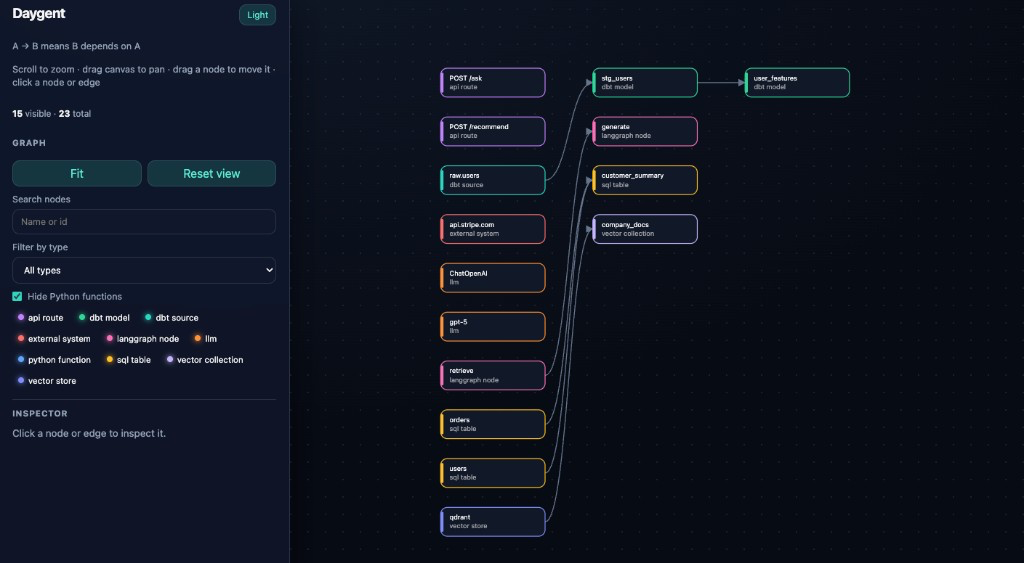
Local-first by designNo production credentials. No warehouse connection. No telemetry.
daygent / graph.html
Daygent offline dependency graph viewer showing connected data and AI nodes
01Repository
02Static parsers
03Dependency graph
04Lineage / impact queries
05Offline HTML viewer
terminalzsh · local
$ pip install daygent

$ daygent scan .
✓ dependency graph written

$ daygent graph --html --open
$ daygent impact <node>

CASE STUDY / 02

Ginja

Adaptive AI Productivity App

3,000+users
iOS + Androidin production

Brain Dump converts unstructured thoughts into structured, actionable tasks and scheduling decisions.

Ginja demonstrates end-to-end product ownership: mobile experience, backend services, AI workflows, data, subscriptions, integrations, analytics, deployment, and continued operation for real users.

React NativeFastAPILangGraph / OpenAISupabase / PostgreSQL
Problem

Turn a stream of unstructured thoughts into a useful plan without forcing users to organize first.

Architecture

React Native clients, FastAPI services, deterministic LangGraph workflows, OpenAI, and PostgreSQL/Supabase.

Production challenges

Reliable structured outputs, notifications, calendar integrations, RevenueCat subscriptions, analytics, and deployment.

Outcome

A live product used by 3,000+ people across iOS and Android—not a standalone LLM demonstration.

System design / How I think

From messy problem to production system.

AI delivery is a loop: the system gets better when discovery and measurement stay connected.

  1. 01

    Discover

    Understand user and business workflow.

  2. 02

    Model

    Define data contracts and system boundaries.

  3. 03

    Prototype

    Validate the smallest useful AI workflow.

  4. 04

    Productionize

    APIs, permissions, observability, fallbacks, evaluations.

  5. 05

    Measure

    Latency, quality, cost, and usage.

  6. 06

    Iterate

    Improve with real-world feedback.

05 / Open source

Tools for understanding complex systems.

I build developer tooling around the hard parts of modern data and AI infrastructure: dependencies, lineage, impact, and change.

MIT License

FEATURED PROJECT

Daygent

Local-first static lineage and blast-radius analysis for repositories that span application code, data platforms, and AI systems.

$ pip install daygent
github.com/emyrael/daygent

06 / Contact

Building an AI product or trying to turn a difficult workflow into a production system?

I'm interested in Forward Deployed, Applied AI, and senior AI engineering problems where software needs to work in the real world.